We learnt about different strategies of solving equations.
The first equation was 84 - 7. We knewed that we can solve this equation by written algorithm, a number line, counting backwards and spliting numbers. We showed the strategies on a DLO.
We showed the strategies we use for 6 equations and put them on a google slide.
To do 84-7, we borrow a ten from 80 that leaves us a 70 so the ten that we borrowed, we add it to the 4 that makes 14, so 14-7 is 7 so the answer is 77.
For the number line we added 3 to the 77 that makes 80 then we add a 4 to 80 that makes 84. So 3 + 4 is 7, so that proves us that 84 - 7 = 77.
For the spliting numbers we subtract 4 from 84 that gives us 80 then we subtract 3 from 80 and got the answer 77.
This activity was easy for me because I knew most of the strategies.
LI: To practice a range of strategies to solve questions using all 4 operations.
Thursday, 23 July 2020

Thursday, 25 June 2020
Frctions | Improper, Proper, MIxed Number and Decimal
Fractions are the equal pieces of a whole object.
Decimals are less than one.
The bottom number of a fraction is called the denoiminator. The denimintor always be the same because if its not the same it gives a different fraction. The top number of a fraction is called the numerator. The numerator is the amount of pieces. If both of the numbers are the same, the fraction is a whole.
Improper fraction are unequal part, the reason why improper fractions are unequal because the numerator is bigger than the deniminator.
Proper fractions are equal parts of the whole because the numerator is less than the denoiminator.
Mixed number fractions are a whole and a part of a fraction. For example 5/3 is the same as 1 whole and 2/3.
Decimals are a short way to write fractions and mixed numbers with denominators that are powers of 10, like 100,1000,10000, etc. If a number has a decimal point, then the first digit to the right of the decimal point describes the number of tenths. For example, the decimal 0.9 is the same as the fraction 9/10 .
Fractions is a good way to learn how to divide things equally.
LI-Mixed number and Improper Fractions.
Improper fraction are unequal part, the reason why improper fractions are unequal because the numerator is bigger than the deniminator.
Proper fractions are equal parts of the whole because the numerator is less than the denoiminator.
Mixed number fractions are a whole and a part of a fraction. For example 5/3 is the same as 1 whole and 2/3.
Decimals are a short way to write fractions and mixed numbers with denominators that are powers of 10, like 100,1000,10000, etc. If a number has a decimal point, then the first digit to the right of the decimal point describes the number of tenths. For example, the decimal 0.9 is the same as the fraction 9/10 .
Fractions is a good way to learn how to divide things equally.
LI-Mixed number and Improper Fractions.
Friday, 19 June 2020
Fractions/Decimals
Fractions are the equal pieces of a whole object.
Decimals are less than one.
The bottom number of a fraction is called the denoiminator. The denimintor always be the same because if its not the same it gives a different fraction. The top number of a fraction is called the numerator. The numerator is the amount of pieces. If both of the numbers are the same, the fraction is a whole.
Decimals are a short way to write fractions and mixed numbers with denominators that are powers of 10, like 100,1000,10000, etc. If a number has a decimal point, then the first digit to the right of the decimal point describes the number of tenths. For example, the decimal 0.3 is the same as the fraction 3/10 .
Fractions is a good way to learn how to divide things equally.
LI: What are fractions and decimal.


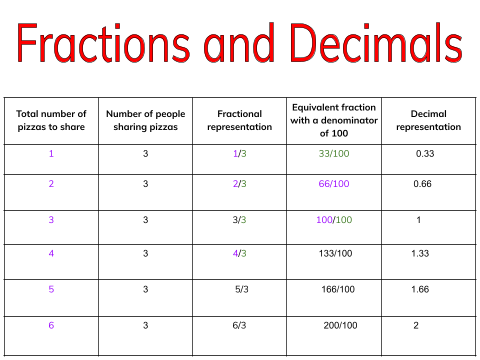
Decimals are a short way to write fractions and mixed numbers with denominators that are powers of 10, like 100,1000,10000, etc. If a number has a decimal point, then the first digit to the right of the decimal point describes the number of tenths. For example, the decimal 0.3 is the same as the fraction 3/10 .
Fractions is a good way to learn how to divide things equally.
LI: What are fractions and decimal.
Friday, 12 June 2020
Volume and Capacity
Volume is how much space something has. Capacity is the amount that something contain. The standard forms are ml (milliliters) and l (liters).
Estimating is a educated guess to the amount of something is. If a person knows how much space in a lunchbox is 300cm cube, then they can compare the space with a measuring tube. If they know how much water are in the measuring tube. They can make a estimation.
Converting is not easy. If a person wants to convert ml (milliliters) to l (liters) just multiply the number by 1000. If the person wants to covert l (liters) to ml (milliliters) just divide the number by 1000
LI-To explore standard forms of Volume and Capacity
Estimating is a educated guess to the amount of something is. If a person knows how much space in a lunchbox is 300cm cube, then they can compare the space with a measuring tube. If they know how much water are in the measuring tube. They can make a estimation.
Converting is not easy. If a person wants to convert ml (milliliters) to l (liters) just multiply the number by 1000. If the person wants to covert l (liters) to ml (milliliters) just divide the number by 1000
LI-To explore standard forms of Volume and Capacity
Maori | Numbers
In Maori we were making a number chart in Te Reo Maori
LI: To create a number chart in Te Reo Maori.
To write numbers in Maori first you need to write whatever number that is the tens. For example, if I want to write the number 89. First I need to find the number in Maori eight is 'waru' in Maori. Then you need to write 'tekau' after waru like this: waru tekau. After that write 'ma' then the ones which is 9 in this case. Nine in Maori is 'iwa'. In the end it should look like: waru tekau ma iwa.
This activity was helpful and I learned new numbers in Te Reo.
This activity was helpful and I learned new numbers in Te Reo.
LI: To create a number chart in Te Reo Maori.
Volleyball
When playing volleyball there are diffferent skills, the first skill to learn should be the set.
What is a set?
A set is a overhead contact with the ball. Sets are usually in serves and when the ball is coming back to the person.
How to do a set?
First the person had to be in a catching hand position, then seperate a gap in the middle of both hands.

After bend the knees a little bit, this is when the person is serving the ball. The reason why the person have to bend the knees a little bit, because to push the ball up.

When the person is serving, the person is not allowed to set the ball with their palm, but their fingers. Because when a person is setting the ball with their palm, the person will not have that much grip, but the fingertips have a good grip on the ball.

In a serve the person have to serve it to the other team to throw it back, but mostly is when the ball is coming back.
Sets are when the person is serving and when the ball is coming back.

After bend the knees a little bit, this is when the person is serving the ball. The reason why the person have to bend the knees a little bit, because to push the ball up.


In a serve the person have to serve it to the other team to throw it back, but mostly is when the ball is coming back.
Sets are when the person is serving and when the ball is coming back.
Thursday, 11 June 2020
Inquiry
Light is something bright that can be seen.
Sound is something loud and quiet that can be heard.
We were learning new vocabulary that was related to light and sound.
To learn all the vocabulary we completed an activity called Matching vocabulary.
When we don't the words we had to look on science dictionary to know the meanings of the words.
When we finish this activity we did another activity called Find, draw, animate and act.
This activity was to show the meanings of the word by an image, a drawing, a animation, or a video.
I made an animation of spectrum. Spectrum is a band of colours like the rainbow, but the colours have no borders.
The words that we did was photon, laser and spectrum and more.
LI: To learn the vocabulary of light and sound.
Sound is something loud and quiet that can be heard.
We were learning new vocabulary that was related to light and sound.
To learn all the vocabulary we completed an activity called Matching vocabulary.
When we don't the words we had to look on science dictionary to know the meanings of the words.
When we finish this activity we did another activity called Find, draw, animate and act.
This activity was to show the meanings of the word by an image, a drawing, a animation, or a video.
I made an animation of spectrum. Spectrum is a band of colours like the rainbow, but the colours have no borders.
The words that we did was photon, laser and spectrum and more.
LI: To learn the vocabulary of light and sound.
Subscribe to:
Posts (Atom)